NeuroTracker has been tried and tested by many independent research centres across the world. Discover the diverse research published with our searchable database
Published Research Papers
Research Institutes Using NeuroTracker
Issued Patents and Patents Pending
NeuroTracker training across a professional baseball season transfers to large improvements in hitting performance for curveballs and sliders.
To assess the performance transfer effects from NeuroTracker training to professional baseball hitting over a competition season.
A 6-minute NeuroTracker cognitive assessment effectively predicts daily trader performance according to objective trading metrics.
To examine if cognitive assessments using NeuroTracker could be predictive of daily trader performance metrics.
A short NeuroTracker training intervention significantly improves fine motor-skills in elderly adults diagnosed with cognitive impairments.
To investigate if older populations with clinically diagnosed cognitive impairments associated with fine-motor skills difficulties could measurably benefit from a short cognitive training intervention.
A short NeuroTracker training intervention significantly improves off-the-block dive reaction times for elite collegiate swimmers.
To to determine if NeuroTracker training could affect off-the-block reaction times, by improving selection attention in university athlete swimmers.
NeuroTracker baselines effectively predict driving safety for both younger and older adults, and experienced and inexperienced drivers.
To investigate NeuroTracker baselines could be predictive of driving performance across 3 simulated scenarios, to see if these measures could be predictive of driving risks.
3-hours of NeuroTracker training improves the passing decision-making accuracy of collegiate soccer athletes by 15% in competitive play.
Attention and concentration are crucial abilities that affect the decision-making of athletes; e.g. during a soccer action, an athlete has to divide attention on the field (teammates, opponents, ball), to use selective attention (which player to give the ball to) and to focus attention (staring at the net to score). To this purpose, many benefits may arise from the high-level NeuroTracker conditioning technique as it stimulates active processing of dynamic visual information and trains perceptual- cognitive functions of athletes. In particular, it targets selective, dynamic and sustained attention, as well as working memory.
Comprehensive pre-post neuropsychological and qEEG neuroimaging assessments reveal robust and wide gains in college students' cognitive abilities.
To examine the effects of NeuroTracker training on standardised measures of attention, working memory, and visual information processing speed using standardized neuropsychological tests. Additionally to measure changes in brain state using functional brain imaging.
NeuroTracker meets gold standard criteria as a cognitive enhancement tool, corroborated with positive pre-post changes in qEEG measures.
To examine the practical efficacy of cognitive enhancement interventions through a gold-standard template for assessing use of such tools, and to assess NeuroTracker evidence against the template for enhancing attention, working memory and visual information processing speed.
A single 6-min NeuroTracker assessment correlates with key NBA competition performance metrics across a season of play.
The purpose of this study was to determine the relationship between visual tracking speed (NeuroTracker) and reaction time on basketball specific measures of performance.
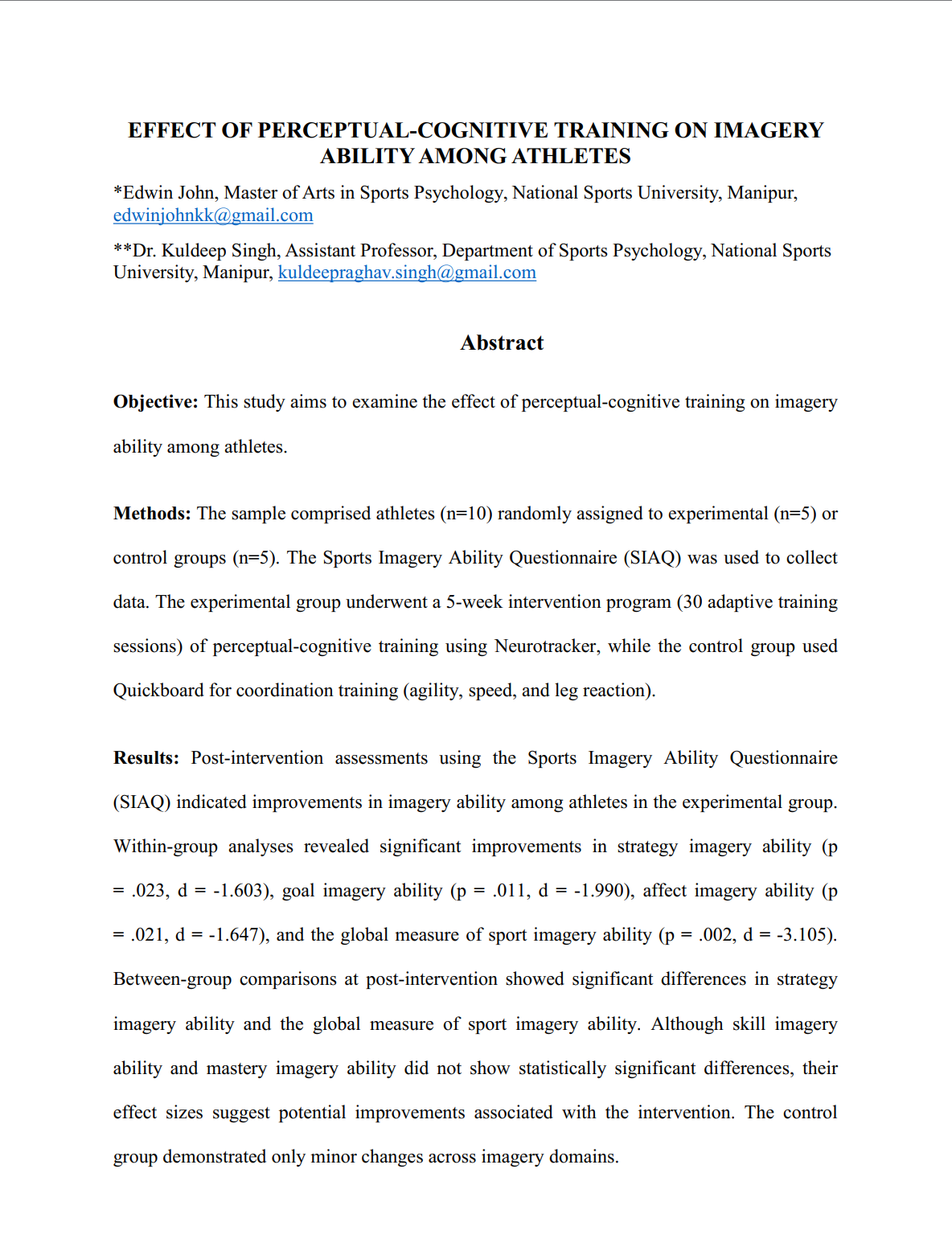
NeuroTracker training may support improvements in athletes’ self-reported sport imagery ability
To examine whether perceptual-cognitive training with NeuroTracker could influence sport imagery ability among athletes.
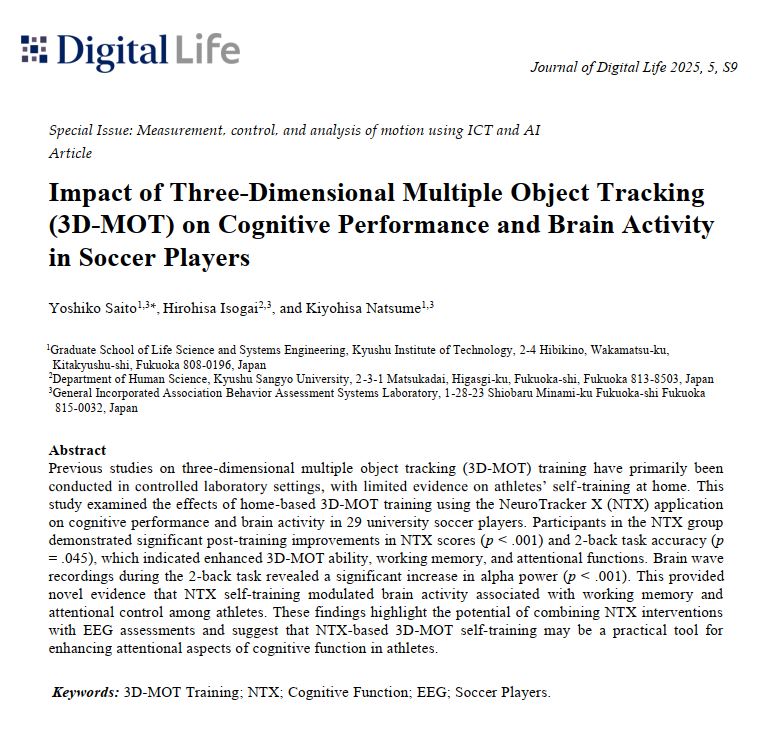
Home-based NeuroTrackerX training improved working memory performance in competitive soccer players, with corresponding changes in brain activity.
To examine whether home-based NeuroTrackerX training improves cognitive performance and modulates brain activity in university-level soccer players.
Performance on a multiple object tracking task predicts take-over success in simulated highly automated driving.
To determine whether visuo-attentional and executive capacities measured by multiple object tracking and related cognitive tasks are associated with take-over performance in a highly automated driving simulation.
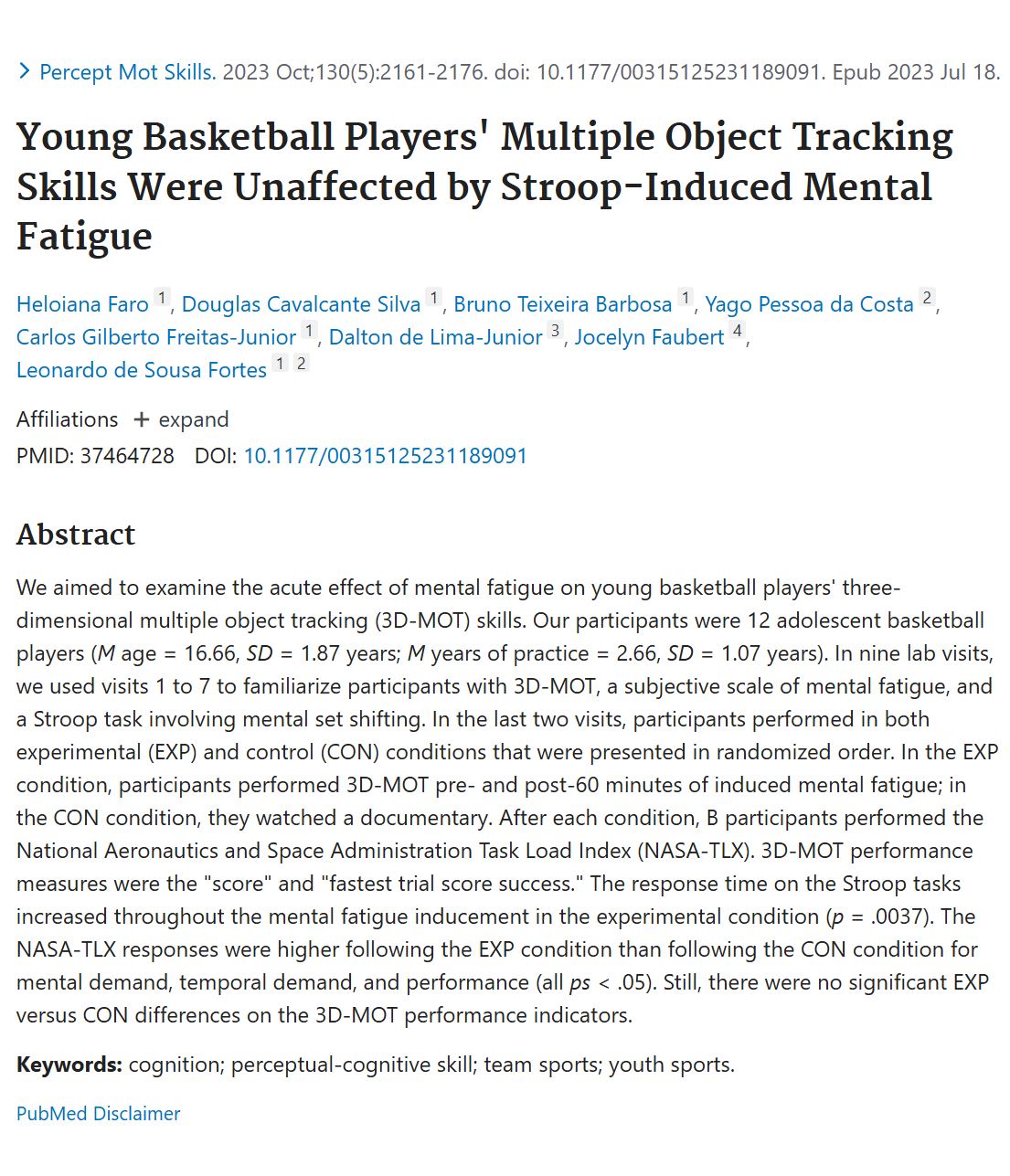
Higher-level basketball players demonstrate superior dynamic visual tracking performance compared to lower-level players in 3D-MOT tasks.
To investigate whether dynamic visual tracking performance measured using a 3D multiple object tracking task differs across basketball players of varying competitive skill levels.
Baseline NeuroTracker performance was not significantly associated with overall season performance metrics in university varsity athletes.
To determine whether baseline NeuroTracker performance predicts overall season sport performance in university varsity athletes.
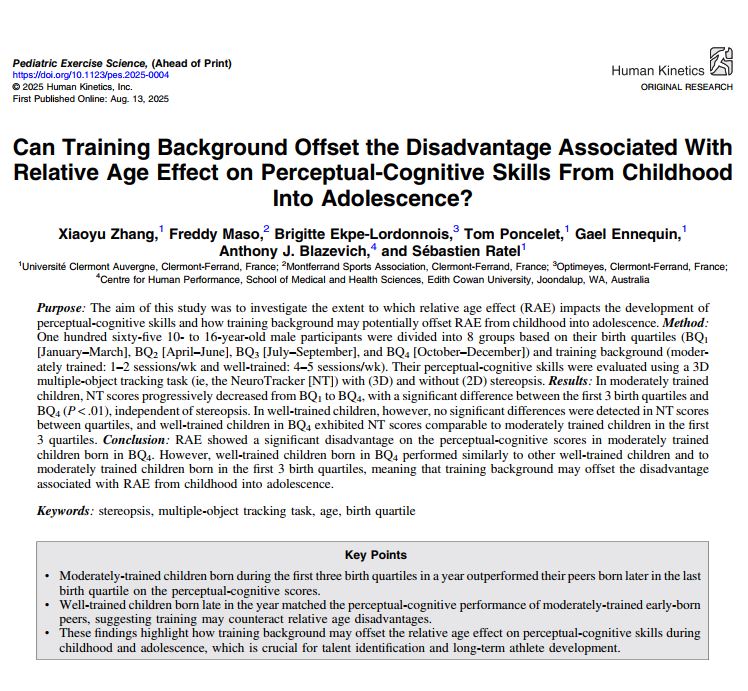
Intensive sports training may offset the perceptual–cognitive disadvantage associated with being relatively younger within an age cohort during childhood and adolescence.
To examine whether relative age (birth quartile), training background, and stereopsis influence perceptual–cognitive performance measured using a 3D multiple object tracking (3D-MOT) task in youth athletes.
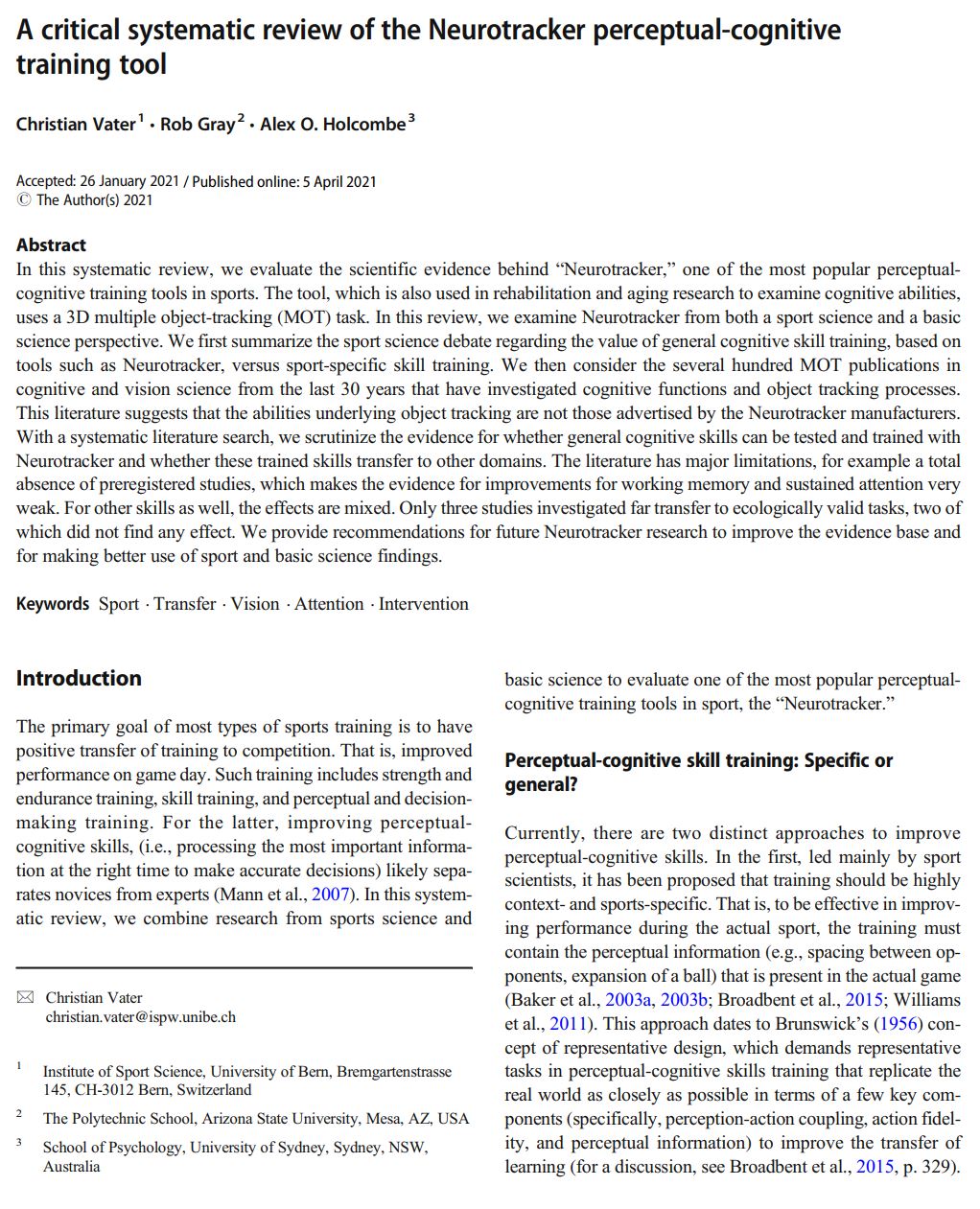
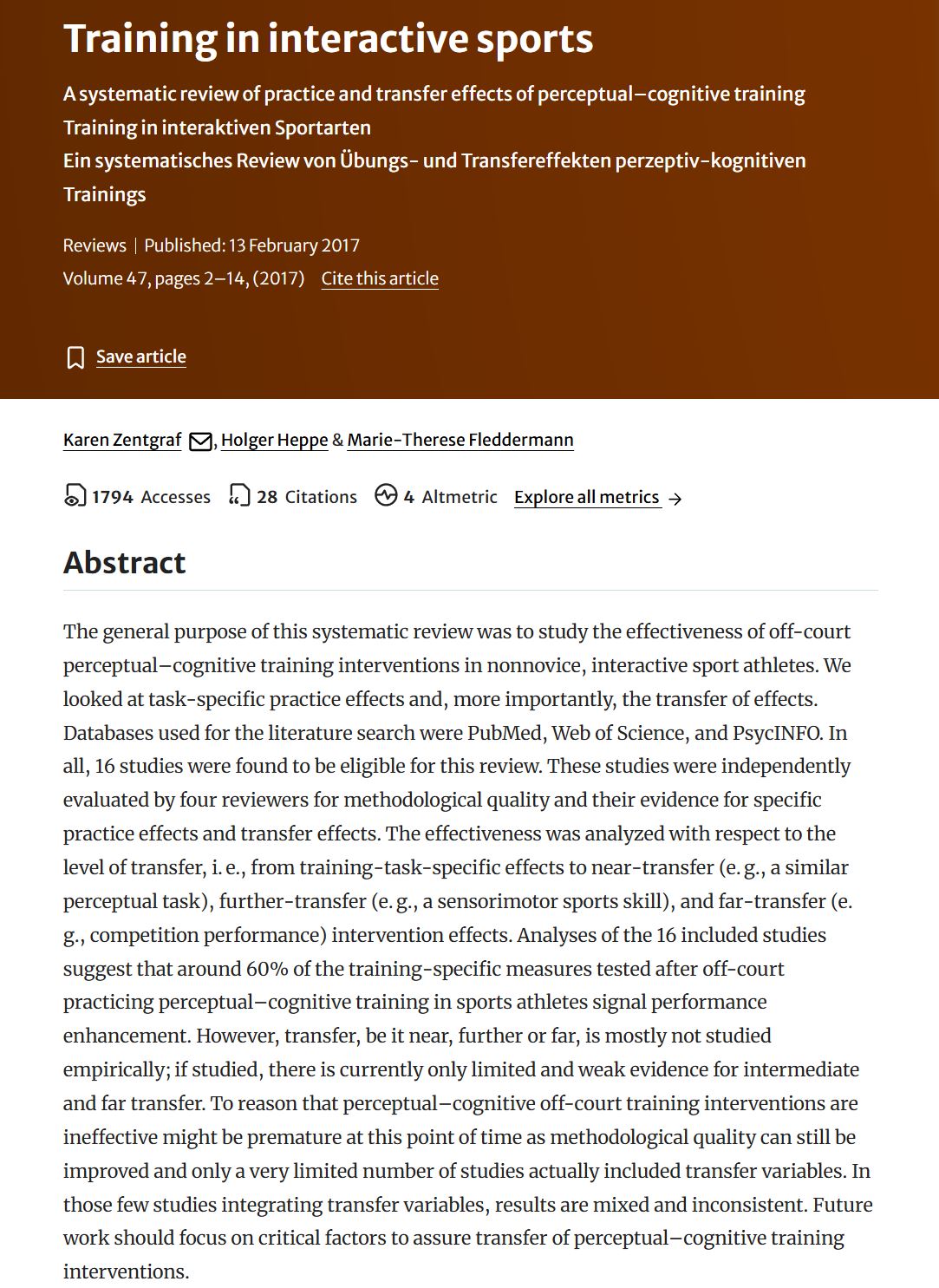
A comprehensive review of multi-object tracking research highlights robust near-transfer effects and mixed evidence for far-transfer across cognitive and applied domains.
To synthesize current evidence on the multi-object tracking (MOT) paradigm as both an assessment tool and a cognitive training intervention, with a focus on transfer effects and underlying perceptual-cognitive mechanisms.
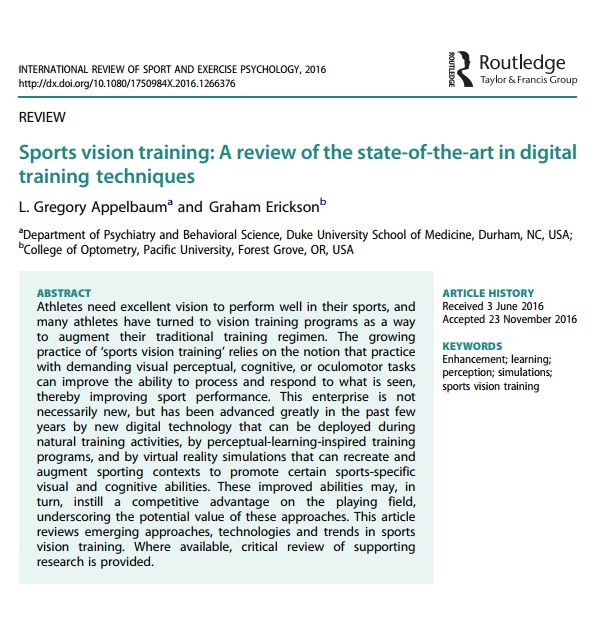
Visual training interventions, including stroboscopic, light board, occlusion, and 3D-MOT approaches, are associated with significant improvements in reaction time in athletes.
To systematically evaluate the effectiveness of visual training interventions on improving simple and choice reaction time (RT) in athletic populations.
Effects of maturity status, training background and stereopsis on perceptual-cognitive skills from childhood into adolescence
To assess how maturity status, sport training background, and stereopsis (depth perception) influence perceptual-cognitive performance across childhood and adolescence using a 3D multiple object tracking (3D-MOT) task.

NeuroTracker is one of the most widely researched cognitive training systems, used in elite sports, military, and human performance settings worldwide. Built on 20 years of neuroscience research.