May 2023
in
Frontiers
To investigate the influence of dietary intake and sleep of esports athletes on cognitive performance and learning capacities measured by NeuroTracker.
119 esports athletes completed a rigorous battery of assessments over an 8-10 day period. This included a comprehensive range of 8 self-assessment surveys, a record of diet, fluid intake and urine color, continuous biometric monitoring of heartrate and sleep quality, and 20 sessions of NeuroTracker distributed over the period.
Average sleep quality was found to be in the range of moderate to severe sleep disturbance and most participants did not meet USDA guidelines for numerous key nutrients, as well as exceeding recommendations for cholesterol, sodium, and saturated fat. NeuroTracker baselines improved on average by around 50% by the end of the 20 sessions (similar to elite athletes). Higher NeuroTracker performance was strongly correlated with better sleep and dietary habits, and specifically, consuming the recommended intake of protein was closely tied to increased learning rates.

NeuroTracker 3D-MOT training was associated with improvements in balance and attentional control, with additional changes observed in dual-task gait and visual-perceptual measures.
To examine whether a visual–spatial attention training intervention using 3D multiple object tracking (3D-MOT) influences motor performance and subsystem measures relevant to occupational performance.
Three pre-test/post-test studies were conducted:
In healthy adults, the intervention groups demonstrated greater improvements in balance performance (SEBT) compared to controls, along with within-group improvements in attentional measures (Stroop). Dual-task gait parameters showed measurable changes following training, though functional improvements were less clearly defined than balance outcomes.
In the single-subject case study, clinically meaningful improvements were observed in visual-perceptual skills, balance subtests, and selected attentional measures, with additional non-clinically significant changes in gait and convergence.
The findings suggest that training visual–spatial attention through 3D-MOT may influence balance and attentional subsystems that contribute to occupational performance, with preliminary evidence of broader functional effects.
Dark sweet cherry supplementation improved working memory in obese adults but did not enhance NeuroTracker-measured visual cognitive performance beyond practice-related gains.
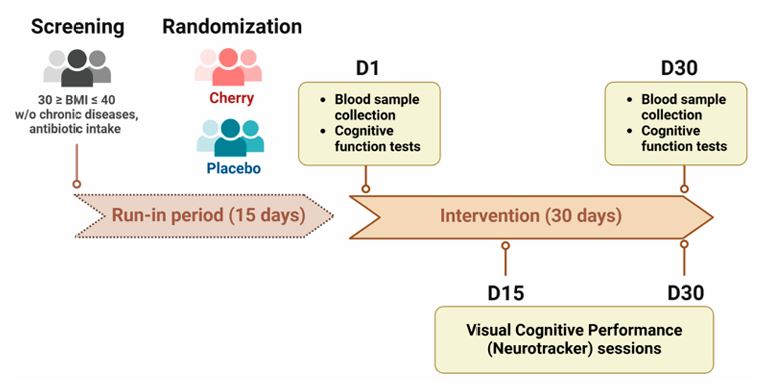
To evaluate whether 30 days of dark sweet cherry (DSC) consumption improves executive function, NeuroTracker 3D-MOT performance, neuropeptide levels, and circadian rhythm biomarkers in adults with obesity.
Method
• Single-blind randomized controlled trial
• 40 adults with BMI 30–40 kg/m²
• DSC drink (200 mL twice daily) vs isocaloric placebo for 30 days
• Executive function assessed using TMT, Digit Span (forward/backward), and DSST
• Visual Cognitive Performance (VCP) assessed via 15 NeuroTracker CORE sessions
• Blood biomarkers: neurotensin, substance P, oxytocin, cortisol, melatonin
NeuroTracker performance was evaluated using speed threshold changes across baseline (sessions 1–3) and final (sessions 13–15) blocks.
Executive Function
• Significant improvements in Digit Span Forward (p = 0.006) and Backward (p = 0.01) in the DSC group
• No between-group differences in TMT or DSST
• Benefits were more pronounced in females and higher BMI subgroup
NeuroTracker (VCP)
• Both cherry and placebo groups improved significantly over 15 sessions (practice effect)
• No significant between-group differences
• Mean change (Δ) VCP: Cherry 0.26 vs Placebo 0.25 (p = 0.94)
Biomarkers
• Neurotensin increased significantly in placebo group only
• Melatonin increased significantly in placebo group only
• No significant treatment effects on cortisol or oxytocin
NeuroTracker meets gold standard criteria as a cognitive enhancement tool, corroborated with positive pre-post changes in qEEG measures.
To examine the practical efficacy of cognitive enhancement interventions through a gold-standard template for assessing use of such tools, and to assess NeuroTracker evidence against the template for enhancing attention, working memory and visual information processing speed.
To assess cognitive tools and NeuroTracker specifically against the following gold-standard criteria and with qEEG findings on changes in neuroelectric brain activity: 1. Robust transfer effects, 2. No Side Effects or Risk of Toxicity, 3. Minimal time and monetary investment, 4) Lasting effects, 5) No ethical issues, 6) Can be used in combination with other interventions, 7) Can be applied to any population.
3-hours of training over 5-weeks with NeuroTracker demonstrated robust effects on attention, working memory, and visual information processing speed as measured by neuropsychological tests. Corresponding changes measured by qEEG were also corroborated these intervention effects. NeuroTracker was concluded to meet the gold standard criteria in points 1, 2, 3, and 5, with some evidence to support the other points, but further research needed.

NeuroTracker training may aid with rehabilitation of visual functions
To evaluate the potential for sports vision training to improve objective and subjective visuomotor function in a low vision patient.
A 37-year-old woman with Usher syndrome underwent a 14-week sports vision training program with pre-post cognitive assessments.
The patient was able to improve the use of remaining visual abilities. A 27 to 31% improvement in hand-eye coordination was achieved along with a 41% improvement NeuroTracker performance. The patient also subjectively reported clear improvements in visual abilities. The researcher concluded sports vision training may reduce the impact of the reduced visual function and aid in activities of daily living.

A variety of egg-based diets over 1-month improve performance on NeuroTracker compared to a no-egg diet.
To evaluate the impact of the nutritional impact of dietary intake of whole eggs, egg white, and egg yolk on visual cognitive performance (NeuroTracker) in healthy older adults.
99 healthy men and women aged 50 to 75 years were randomly assigned to one of five groups with different daily consumption of eggs alongside a record of their usual dietary intake. Over 1-month period participants either consumed four egg whites, two whole regular eggs, two whole omega-3-fortified eggs, four egg yolks, or no eggs (control). During the final 2 weeks of the study all participants completed 15 NeuroTracker.
On average male participants performed significantly better at NeuroTracker than females. All participants on egg and no-egg based diets significantly improved their NeuroTracker performance across 2-weeks.

NeuroTracker learning rates and neuropsychological assessments reveal that professional action video gamers possess superior attentional capacities.
To assess the extent to which action video game players perform better than non-gamers on cognitive functions measured by NeuroTracker and neuropsychological assessments.
14 professional and 16 amateur action video game players completed a battery of 7 standardized neuropsychological assessments, a manual dexterity test, and 14 NeuroTracker sessions. Statistical analysis techniques were used to compare cognitive differences.
Analysis revealed that high performance in professional action video games players is associated with enhanced abilities in visual spatial attention, visual and auditory short-term memory, and selective and sustained attention. No significant differences between professionals and amateurs were evident on tasks evaluating executive functions, perceptual manipulation, or manual dexterity. Although both groups displayed a similar learning capacity to improve at NeuroTracker over 90-mins of training, professionals exhibited a distinct performance advantage throughout the intervention. The results overall suggest that elite action video gamers have superior attentional control.


NeuroTracker is one of the most widely researched cognitive training systems, used in elite sports, military, and human performance settings worldwide. Built on 20 years of neuroscience research.