October 2017
in
PLoS One
To investigate NeuroTracker baselines could be predictive of driving performance across 3 simulated scenarios, to see if these measures could be predictive of driving risks.
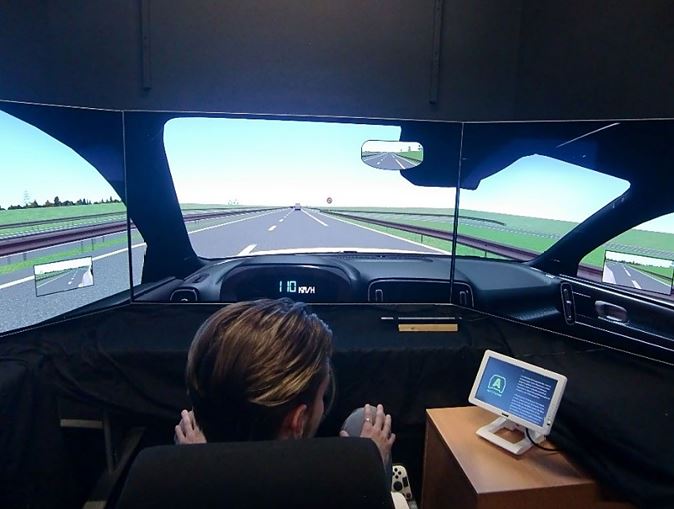
115 drivers were divided into three age and experience groups: young inexperienced (18-21 years old), adult experienced (25-55 years old) and older adult (70-86 years old). Participants were tested for 2 hours across three different driving scenarios varying in mental workload (low, medium, high), using a highly sophisticated driving simulator. A total of 18 different metrics on driving behavior were evaluated and compared to NeuroTracker baseline scores.
Statistical analysis of NeuroTracker results and driving performance metric yielded significant correlations, including being predictive of driving speed, breaking speed, and reaction to dangerous events. Low NeuroTracker scores effectively predicted elevated risks of crashes. Lower NeuroTracker scores also correlated significantly with slower average driving speed for older adults, providing evidence towards the theory that driving more slowly is related to the cognitive effects of aging.

Performance on a multiple object tracking task predicts take-over success in simulated highly automated driving.
To determine whether visuo-attentional and executive capacities measured by multiple object tracking and related cognitive tasks are associated with take-over performance in a highly automated driving simulation.
Participants completed a battery of cognitive assessments including 3D multiple object tracking (NeuroTracker), executive function measures, and additional visuo-attentional tasks. These measures were correlated with performance outcomes in a high-fidelity driving simulator requiring participants to take over control from automated driving under risk-relevant conditions.
Higher dynamic tracking performance and stronger executive functioning were associated with greater take-over success in the simulated automated driving scenarios. These findings suggest that perceptual-cognitive abilities measured by 3D-MOT paradigms relate to practical visuomotor tasks beyond sport contexts, including safety-critical driving behaviors.
A variety of egg-based diets over 1-month improve performance on NeuroTracker compared to a no-egg diet.
To evaluate the impact of the nutritional impact of dietary intake of whole eggs, egg white, and egg yolk on visual cognitive performance (NeuroTracker) in healthy older adults.
99 healthy men and women aged 50 to 75 years were randomly assigned to one of five groups with different daily consumption of eggs alongside a record of their usual dietary intake. Over 1-month period participants either consumed four egg whites, two whole regular eggs, two whole omega-3-fortified eggs, four egg yolks, or no eggs (control). During the final 2 weeks of the study all participants completed 15 NeuroTracker.
On average male participants performed significantly better at NeuroTracker than females. All participants on egg and no-egg based diets significantly improved their NeuroTracker performance across 2-weeks.

NeuroTracker training transfers to significantly improved useful field of view, an ability strongly associated with driving skills.
To examine if NeuroTracker training transfers to useful field of view (UFOV) performance, a measure strongly associated with driving performance.
Twenty healthy young adults between the ages of 23 and 33 years were recruited and evenly assigned to either a NeuroTracker training program or active control group using a math game (2048). Both groups completed 5 hours of training distributed over 5 weeks. Both groups completed pre-post standardized assessments of UFOV.
The NeuroTracker training group exhibited significantly improved UFOV performance, whereas the active control group showed only a small, statistically nonsignificant improvement in the task. The researchers suggest that NeuroTracker and UFOV performance are likely dependent on overlapping cognitive abilities, and that these abilities can be trained and measured in young adults which could lead to improving driving safety.

Perceptual cognitive training improves biological motion perception evidence for transferability of training in healthy aging
To investigate if the decline in biological motion perception associated with healthy aging can be reversed with a short NeuroTracker training intervention.
13 participants completed 3-hours of NeuroTracker training over 5-weeks, and 28 control participants did either experimental training or no training (overall mean age of 67 years old). Pre-post assessments of biological motion perception was assessed with a VR walker (point like display) at 4m and 16m.
Pre-NeuroTracker training participants displayed significantly lower performance for interpreting human movement at 4m, compared to 16m. Controls showed no change post-training, whereas the NeuroTracker trained group's performance at 4m rose to the level of their performance at 16m. As biological motion perception abilities are deemed to be important for social skills, as well as critical for collision avoidance at 4m, the researchers concluded that the results demonstrate NeuroTracker to be a useful form of generic training for helping older people deal with socially relevant dynamic scenes.

Several studies have shown that aerobic exercise can slow age-related cognitive decline, and in some cases, improve cognitive function in the older population. The purpose of this study was to investigate for the first time, the effects of resistance training on cognitive function, as measured by changes in NeuroTracker measures.
25 older adults with a mean age of 70yrs were split into a trained group (6 weeks of resistance exercises), and an untrained group. Perceptual-cognitive ability was measured pre and post training using NeuroTracker baselines.
The older adults who performed six weeks of resistance training experienced significant improvements in perceptual-cognitive function as measured by NeuroTracker. Resistance training may therefore be an effective means to slow age related cognitive decline.
.jpeg)
NeuroTracker baselines in 2D and 3D reveal lower binocular stereo abilities for health children and older people compared to adults.
3D vision (binocular stereo) develops during childhood and tends to reduce after 65 years of age. This study aimed to investigate whether these effects are significant when processing complex and dynamic motion.
Three groups of 20 subjects were recruited: children (7–12 years old), adults (18–40 years old) and older adults (≥65 years old). Each person completed 4 NeuroTracker sessions, 2 in 2D (no binocular stereo) and 2 in 3D (with binocular stereo).
As typical, adults achieved significantly higher NeuroTracker scores than children or elderly. They also gained a significantly larger advantage when performing NeuroTracker in 3D. In turn, children showed more advantage with 3D than elderly. This suggests that older populations have reduced ability to process complex and dynamic motion using stereoscopic processing. This study reveals that comparison between scores with and without stereoscopic effect, allows direct evaluation of the stereopsis advantage when performing NeuroTracker.


NeuroTracker is one of the most widely researched cognitive training systems, used in elite sports, military, and human performance settings worldwide. Built on 20 years of neuroscience research.