



Welcome to the Research and Strategy Services at in today's fast-paced.
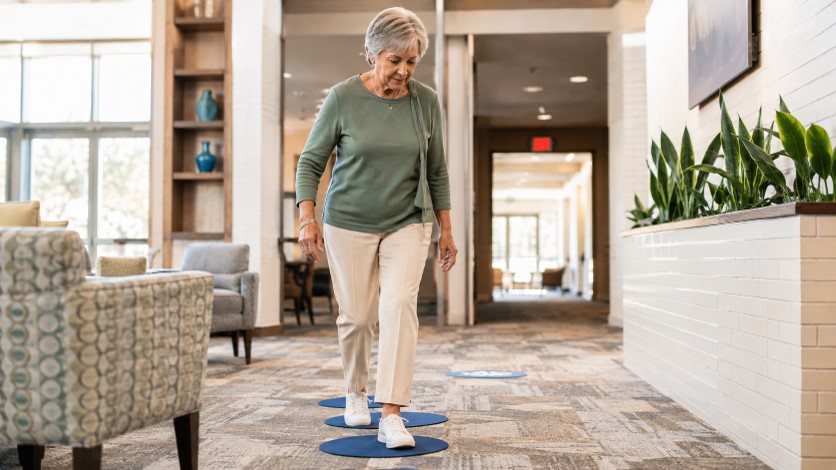
Aging is often discussed in terms of decline.
Slower reactions. Reduced memory. Changes in balance, movement, attention, and processing speed.
Those changes are real—but they can overshadow another part of the story.
The aging brain may still retain a meaningful capacity to learn, adapt, and respond to new cognitive demands.
That potential is easy to underestimate because most everyday measures of aging focus on what has been lost rather than what can still change.
A growing body of NeuroTracker research offers an interesting window into this question. Across several small studies, older adults showed evidence of continued perceptual-cognitive learning, improvements in specific cognitive abilities, and relationships between cognitive change and functions relevant to everyday life.
These studies are preliminary, but together they suggest that cognitive adaptability may remain an important part of healthy aging.
Scientific Study: Healthy Aging Study: NeuroTracker Learning
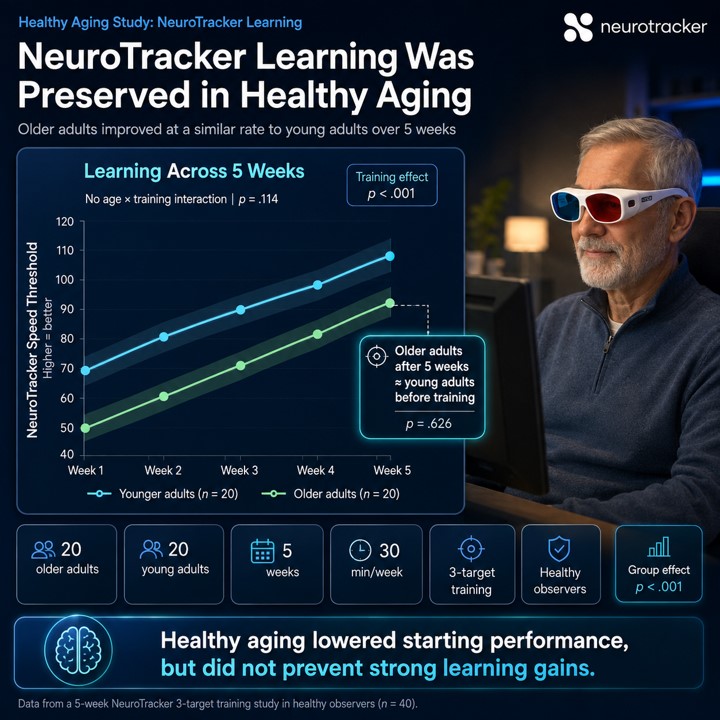
In this study, healthy older adults began with lower NeuroTracker performance than younger adults, but improved at a similar rate across five weeks of training.
The important distinction is that lower starting performance did not mean reduced learning capacity. Aging affected baseline performance, while the ability to improve remained strongly preserved.
This is a useful reminder that cognitive aging is not simply a story of progressive loss. Even when capacity changes, adaptability may remain.
Scientific Study: Healthy Aging Study: Biological Motion Perception
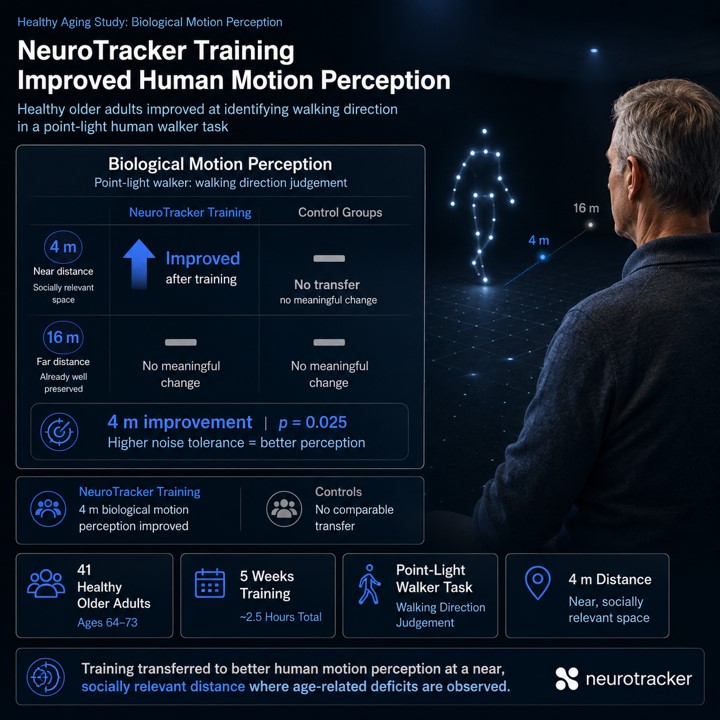
After NeuroTracker training, healthy older adults improved at judging the direction of a point-light human walker at a near, socially relevant distance, while control groups showed no comparable transfer.
The finding is especially interesting because biological motion perception sits close to everyday function. Interpreting how another person is moving—where they are going, how quickly they are approaching, what their body is doing—is part of navigating social and physical environments continuously.
It provides an example of cognitive training extending beyond the training task itself into another form of dynamic visual perception.
Scientific Study: Healthy Aging Study: Attention & Dynamic Balance
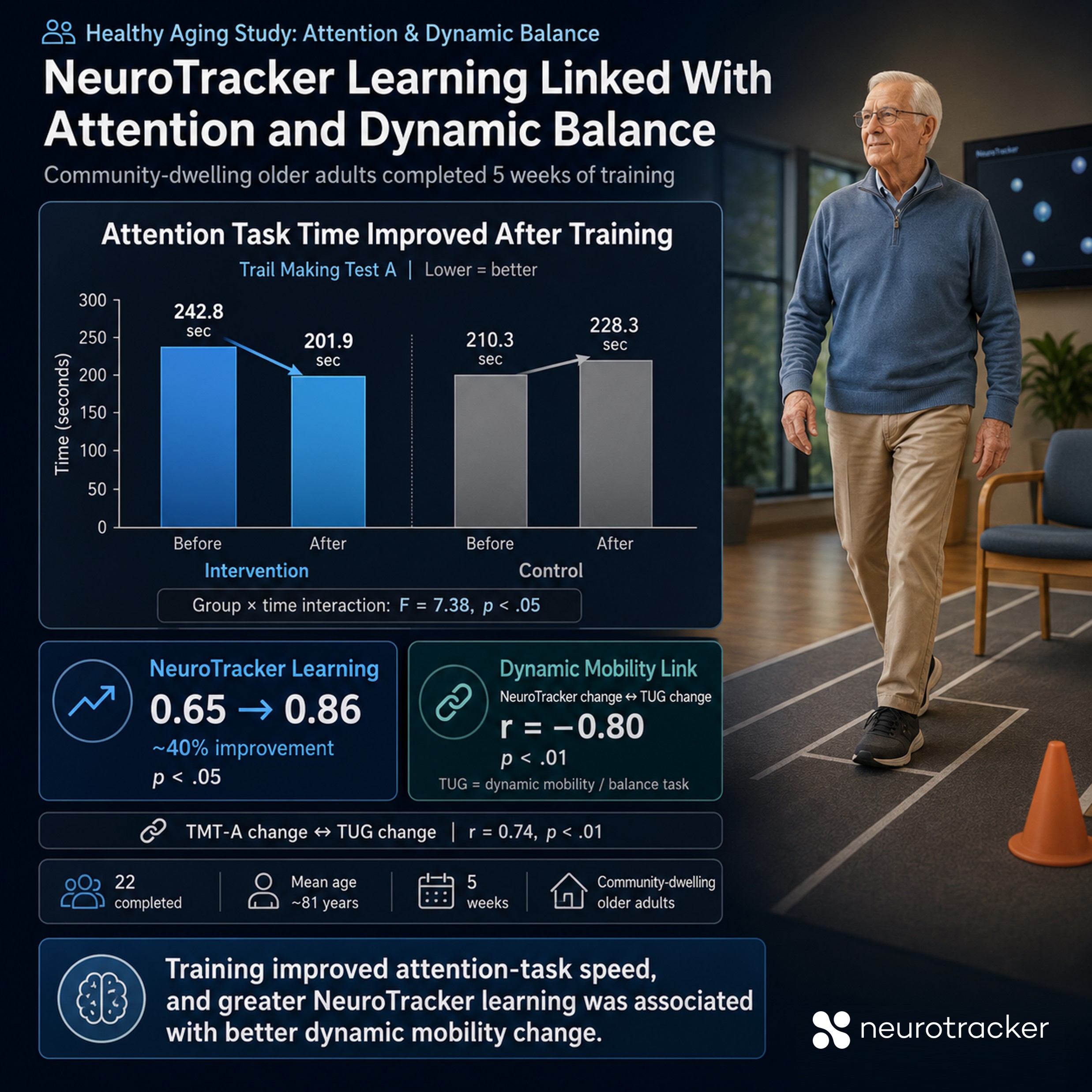
Community-dwelling older adults improved on an attention task after five weeks of training, while greater NeuroTracker learning was also associated with better change on a dynamic mobility and balance measure.
This does not establish that cognitive training directly caused the mobility changes, but the relationship is notable.
Attention, movement, and balance are often treated as separate abilities. In daily life they rarely operate separately. Walking through a crowded environment, changing direction, avoiding obstacles, or responding to another person all depend on cognition and movement working together.
The study therefore offers another glimpse of how cognitive adaptability may relate to abilities that matter beyond a computer screen.
Scientific Study: Healthy Aging Study: Subjective Cognitive Decline
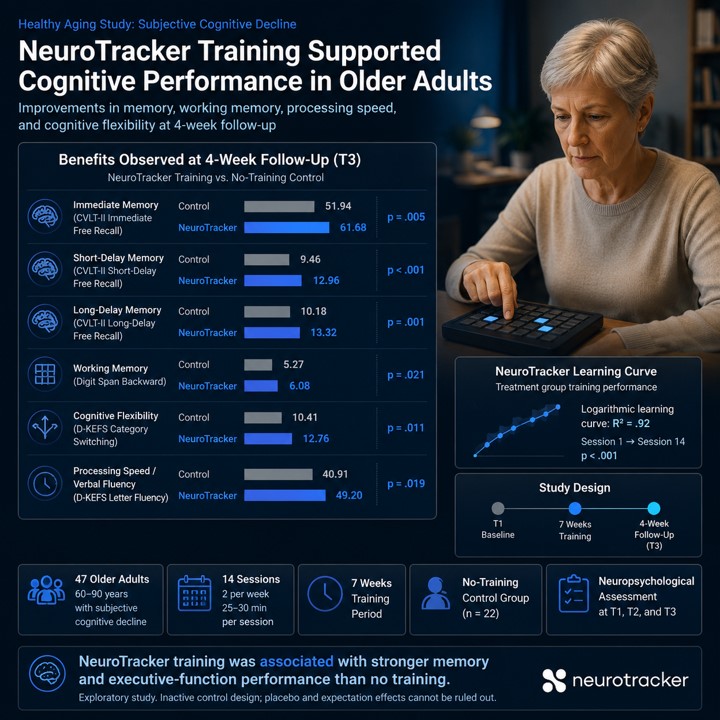
In an exploratory study of older adults with subjective cognitive decline, NeuroTracker training was associated with stronger performance than a no-training control group across several measures including memory, working memory, processing speed, and cognitive flexibility at follow-up.
The study used an inactive control, so placebo and expectation effects cannot be ruled out. The findings should therefore be interpreted cautiously.
Even with that limitation, the breadth of the observed changes is interesting because it raises a larger question: how much cognitive adaptability remains available in later life, particularly when the brain is given sustained and appropriately challenging stimulation?
One reason cognitive adaptability receives less attention than cognitive decline is that decline is easier to observe.
We notice when memory becomes slower.
We notice when reactions change.
We notice when tasks that were once easy begin to require more effort.
Adaptability is less visible.
It reveals itself only when the brain is challenged, given time to learn, and measured across repeated experience.
That creates a very different way of thinking about aging.
Instead of asking only:
What abilities decline with age?
we can also ask:
Which abilities remain trainable, and how much capacity for adaptation is still available?
The studies above do not provide a complete answer.
But together they point toward an encouraging possibility: older brains may retain more capacity for learning and change than everyday observation suggests.
Across these NeuroTracker studies, several themes recur.
Older adults continued to learn.
Training effects extended into other perceptual and cognitive measures.
Cognitive change was linked with aspects of physical function.
And broader cognitive abilities appeared responsive even in people already reporting cognitive decline.
These are early findings, not definitive evidence that cognitive training can preserve independence or prevent age-related decline. But they provide a useful glimpse of something that may be easy to miss:
the aging brain is not simply a declining system—it remains an adaptive one.
Future neuroscience will likely reveal a much richer picture of how that adaptability can be supported, measured, and translated into meaningful cognitive abilities later in life.
The studies we have today may represent only a small part of that picture. But what they suggest is that healthy aging may depend not only on protecting what we have, but also on understanding how much capacity remains to keep adapting and learning in ways that support daily quality of life.
Summaries of 120+ NeuroTracker studies can be viewed here: NeuroTracker Science Portal
Welcome to the Research and Strategy Services at in today's fast-paced.
The brain and body are often treated as separate systems, but NeuroTracker research suggests they are deeply connected. This review explores how perception, decision-making, attention, and movement interact across sport, driving, aging, fatigue, and motor performance.
Learn about an 11 year old boy's inspiring achievements using NeuroTracker training for sports and educational performance.
A new controlled study shows that remote NeuroTrackerX training improved attentional performance and frontal alpha brain activity in university soccer players.
NeuroTracker is one of the most widely researched cognitive training systems, used in elite sports, military, and human performance settings worldwide. Built on 20 years of neuroscience research.