


Welcome to the Research and Strategy Services at in today's fast-paced.
Giulio Bertelli is an Italian sailor, filmmaker, and entrepreneur. He is the son of Miuccia Prada and Patrizio Bertelli, the leaders of the Prada Group, yet chose to forge his own path outside the fashion world. His early career was in high-performance sailing, competing in the America’s Cup with Luna Rossa and taking part in ocean racing campaigns such as The Ocean Race. Alongside sport, he pursued design, studying architecture at the Architectural Association in London.
Now, with Agon as his debut feature, Bertelli has entered the world of cinema on his own terms. Drawing on both his background in elite sport and his design sensibilities, he has developed what he calls a style of “techno-realism” — a hybrid form of documentary and fiction that interrogates identity, performance, and the psychological costs of competition.
Agon premiered at Venice International Film Critics’ Week, where it won the Luciano Sovena Award for Best Independent Production. It has drawn praise from critics for its unorthodox, layered approach:
These assessments highlight Agon’s strength as a film that prioritizes psychological depth, bodily risk, and the internal landscapes of athletes, rather than traditional narratives of victory or overcoming.
One of the more intriguing sequences for those familiar with cognitive training appears in a brief fencing training scene. Here, a coach introduces NeuroTracker, a 3D perceptual training tool, telling the athlete:
“Remember, the eyes are the brain’s video camera. The optic nerve is what interacts with the brain.”
Bertelli’s decision to include NeuroTracker is rooted in his own experience. As a sailor, he trained with NeuroTracker to strengthen his mental focus and attention, skills essential for decision-making under pressure on the water. Based on these hands-on insights, NeuroTracker fit as an authentic feature in Agon — a reflection of how cognitive training intersects with elite sport.
After reaching out to request permission for its inclusion, Bertelli kindly welcomed NeuroTracker’s CEO Jonathan and his family to his studio in Italy during their holiday. The visit underscored a collaborative spirit behind the scene.
Agon is not a conventional sports drama. Instead, it operates as a meditation on performance, sacrifice, and identity. The film interrogates what is visible and invisible in athleticism—both in terms of physical exertion and psychological burden—and asks viewers to consider how much of the athlete’s journey is shaped by external expectation versus internal struggle.
For audiences open to ambiguity and thoughtful pacing, Agon provides a resonant and sometimes unsettling look at what it means to compete, to perform, and to endure.
Welcome to the Research and Strategy Services at in today's fast-paced.
Pilots don’t just control where the aircraft is — they continuously anticipate where it is heading next. This article explores how prediction, workload management, and future-state awareness help pilots stay ahead of the aircraft.
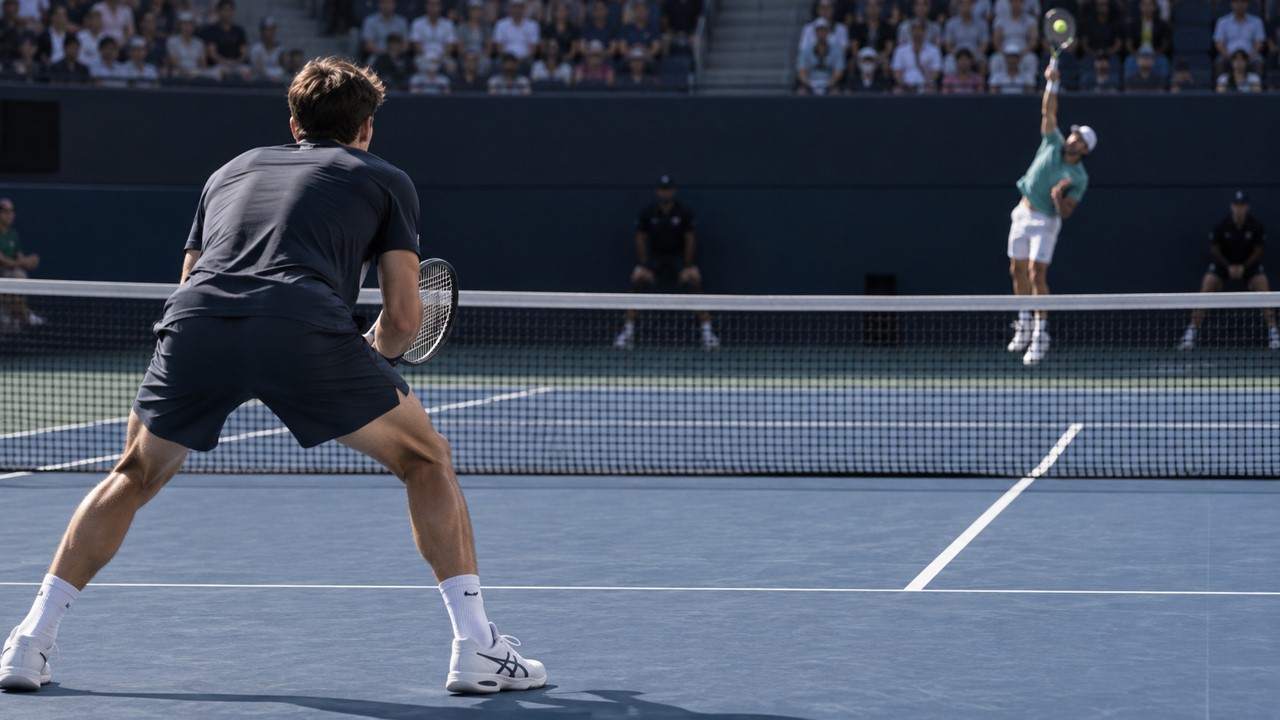
Elite tennis returners do more than react quickly — they extract useful information before the ball is even struck. This article explores how anticipation, body cues, and rapid updating help players solve the return before the serve fully unfolds.
Elite athletes don’t need to look directly at everything to stay aware of a fast-changing play. This article explores how gaze and attention work together to monitor movement, spacing, and opportunity across the wider visual field.
NeuroTracker is one of the most widely researched cognitive training systems, used in elite sports, military, and human performance settings worldwide. Built on 20 years of neuroscience research.