


Welcome to the Research and Strategy Services at in today's fast-paced.
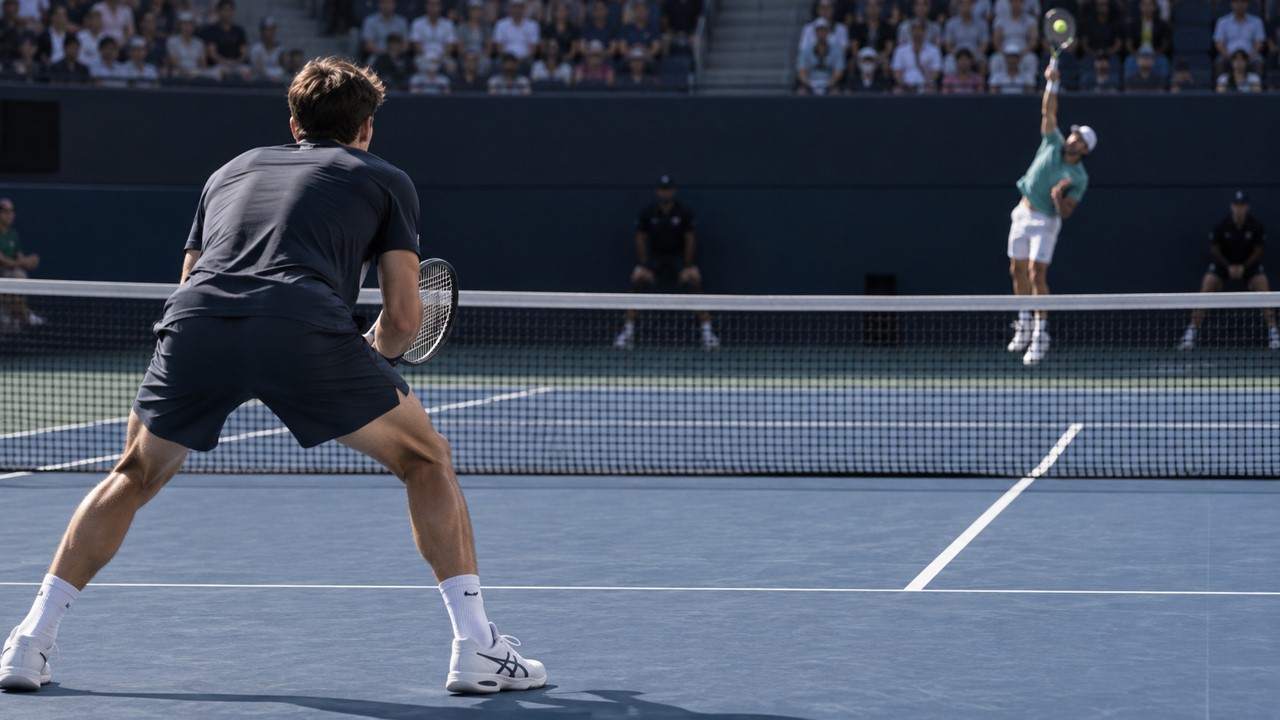
A professional tennis serve can arrive at well over 200 km/h.
By the time the ball leaves the server’s racket, the receiver has only a fraction of a second to determine where it is going, move into position, prepare the racket, and begin a return.
That is too little time to rely on ball flight alone.
Elite returners solve the problem by starting earlier.
Before the ball has even been struck, they are already gathering information from the server’s body, movement, positioning, and preparation. The return begins not with a reaction to the ball, but with a prediction about what is likely to happen next.
This is one of the clearest examples of how expert performance depends on extracting useful information before the decisive event occurs.

From the stands, returning serve can look like a simple sequence: the server hits the ball, the receiver sees where it is going, and then reacts.
At elite speeds, the timing makes that interpretation difficult to sustain. A tennis court is 23.77 metres long, and first serves at the professional level routinely approach or exceed 200 km/h. In a recent Grand Slam example, Alexander Zverev averaged 205 km/h on first serve and reached 225 km/h.
At 200 km/h, the ball is travelling at about 55 metres per second. Even allowing for the bounce and loss of speed, the receiver is dealing with a total flight time measured in only a few hundred milliseconds. Research on expert returners has found that key return movements begin extremely early: the split-step is coordinated around racket-ball contact, with lateral movement beginning around 177 milliseconds after the server strikes the ball. This is very close to the timescale of a single blink.
That leaves very little time to wait for the ball’s trajectory to become fully obvious before deciding what to do.
The receiver still has to estimate direction, anticipate the bounce, organize body position, prepare the racket, and begin moving. Just as a goalkeeper facing a penalty cannot wait until the shot is fully readable, an elite tennis returner has to start solving the problem before all of the information is available.
The cognitive problem is therefore not simply:
Where is the ball going?
It is:
What is most likely to happen, given the information available before and immediately after contact?
A tennis serve is not a single instant.
It is a structured movement sequence.
Before the racket reaches the ball, the server has already produced information through:
None of these cues necessarily tells the receiver exactly where the serve will go. But together they can narrow the possibilities.
An elite returner is therefore not waiting passively for the ball to appear. They are continuously updating expectations as the server moves through the service action.
The closer the movement gets to contact, the more informative some of those cues can become.
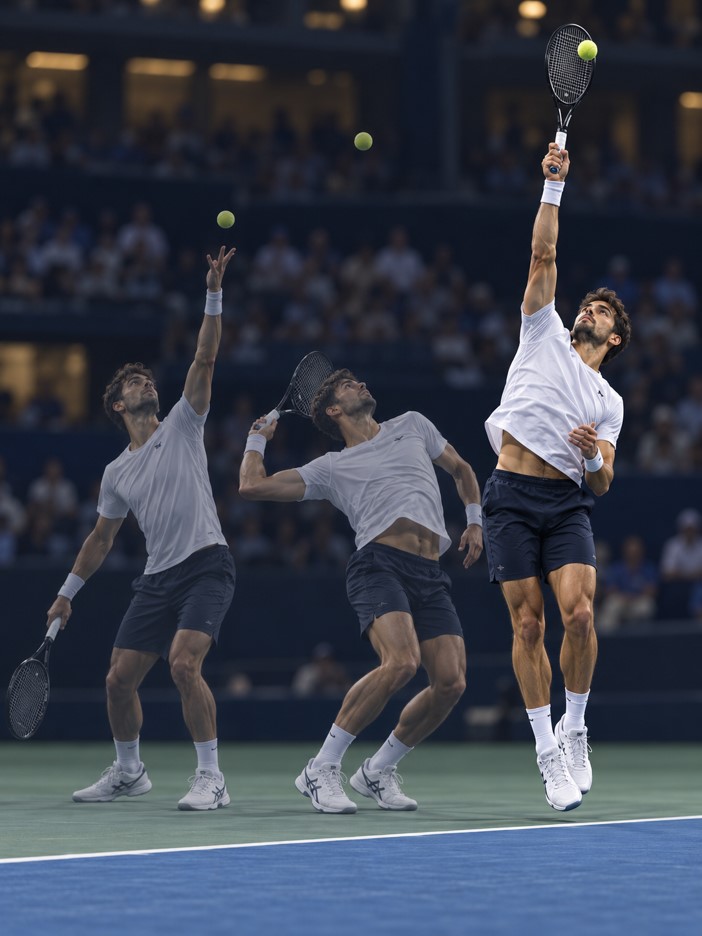
Consider the difference between watching a still image of a server and watching the full service motion.
The still image provides information about position.
The movement provides information about what is developing.
A small change in racket path, trunk rotation, contact preparation, or ball toss may alter the probability of different serves. Expert players become sensitive to patterns within these movements. Importantly, this does not mean they consciously analyze every joint angle during a match.
Much of the process can happen rapidly and implicitly.
With extensive experience, certain movement patterns become associated with particular outcomes. The returner begins to recognize what a developing serve is likely to produce.
That is closer to pattern recognition than deliberate calculation.
Anticipation is sometimes misunderstood as guessing. They are not the same thing.
A guess can be made without useful evidence. Anticipation uses partial evidence to change the probability of different outcomes.
Suppose a returner judges that a wide serve is becoming more likely. They do not need absolute certainty for that information to be useful.
Even a slight shift in expectation can influence:
The player may still revise the response as the ball leaves the racket.
In this way, anticipation does not replace reaction. It gives reaction a head start.
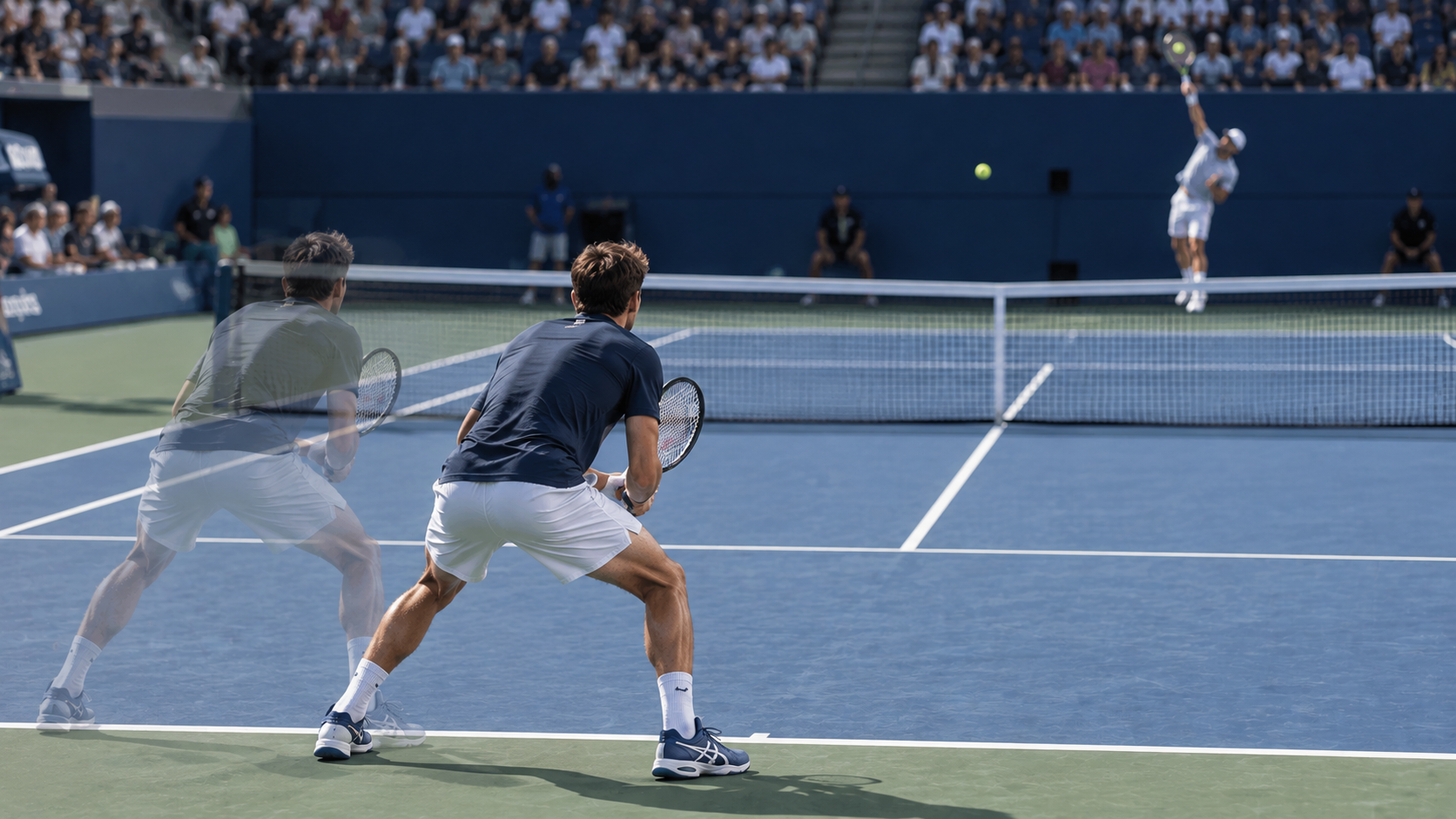
Once racket contact occurs, a new stream of information becomes available.
The returner can now use:
This information either supports the developing expectation or forces it to change.
Expert performance therefore involves a rapid sequence:
anticipate → observe → update → act
The first prediction does not have to be perfect.
What matters is that it moves the player toward an appropriate response early enough while still allowing correction when new information arrives.
This is a recurring feature of skilled behavior.
Experts often begin acting before they possess complete information because waiting for certainty would make them too late.
A novice and an expert can watch exactly the same serve and receive very different amounts of useful information from it.
The visual scene is the same.
What differs is what the observer has learned to treat as meaningful.
A novice may primarily see:
An expert may detect relationships between different phases of the movement that carry predictive value. This is one of the defining characteristics of perceptual expertise.
Experience changes not only what a person knows, but what information becomes noticeable and useful.
A cue that means almost nothing to a beginner may immediately alter an expert’s expectation.
Another part of expertise is learning which information deserves trust.
Some movements may strongly predict what follows. Others may be misleading, variable, or deliberately disguised.
Elite servers can also reduce predictability by making different serves look similar during their early preparation.
This creates a contest between information and deception. The returner is trying to identify meaningful differences as early as possible. The server is often trying to delay those differences until as late as possible.
This is one reason elite sport becomes cognitively interesting: performance depends not just on producing movement, but on controlling and interpreting the information that movement reveals.
Reading a serve also requires efficient visual attention. The receiver cannot scrutinize every part of the server’s body independently.
Instead, useful information must be sampled from the overall movement pattern while attention shifts toward the cues that become important at different stages.
Before contact, body movement carries much of the predictive information. Immediately after contact, the ball rapidly becomes more informative.
Attention therefore has to transition from reading the action to tracking the outcome.
That transition happens extremely quickly.
A poorly timed shift can matter. Look to the ball too early and useful preparatory information may be missed. Stay focused on the server too long and the initial ball trajectory may be lost.
Expert visual behavior is partly about getting that timing right.
Reaction speed certainly matters in tennis.
But describing elite returners as having extraordinary reflexes misses much of what makes their performance possible.
Their advantage also comes from reducing uncertainty before the ball arrives.
They use:
to begin solving the return before the situation is fully known.
The physical response then builds on that perceptual head start.
This distinction matters because it changes how we think about fst performance. The best performers are not simply reacting faster to the same information. They are often extracting useful information earlier.
Tennis makes predictive perception easy to see because the timing is so unforgiving. A receiver cannot wait for complete certainty about a 200 km/h serve and then decide what to do.
Instead, the brain uses the server’s unfolding movement to construct an expectation, then continually revises that expectation as better information becomes available.
What appears from the outside to be an astonishingly fast reaction is therefore partly something else. It is anticipation.
Elite returners are not waiting for the future to arrive before they respond. They are using the present to predict what the next fraction of a second is likely to contain.
Welcome to the Research and Strategy Services at in today's fast-paced.
Elite athletes often anticipate an opponent’s next move before the action fully unfolds. This article explores how reading subtle body movements helps experts predict actions, reduce uncertainty, and respond ahead of time.
At Formula 1 speeds, performance depends on far more than fast reactions. This article explores how elite drivers prioritize information, anticipate what comes next, and continuously update the race at extreme speed.
Elite athletes don’t need to look directly at everything to stay aware of a fast-changing play. This article explores how gaze and attention work together to monitor movement, spacing, and opportunity across the wider visual field.
NeuroTracker is one of the most widely researched cognitive training systems, used in elite sports, military, and human performance settings worldwide. Built on 20 years of neuroscience research.