

August 2021
in
International Journal of MS Care


To assess the usability of NeuroTracker in patients with MS and their responsiveness to cognitive training effects. Standardized neuropyschological assessments and a driving readiness test (Useful Field of View).

16 patients with MS and 9 age-matched controls completed four 30-minute NeuroTracker training sessions.

MS patients scored lower than controls, however their scores improved at the same rate, suggesting a healthy response to training. Pre-post Neuropsychological assessments showed non-significant changes from training effects, with small to medium effect sizes. For the MS group, the driving readiness test showed a significant increase post-training. The researchers concluded that NeuroTracker can be used to train cognitive skills in patients with MS and may improve may improve real-life functioning such as driving safety.

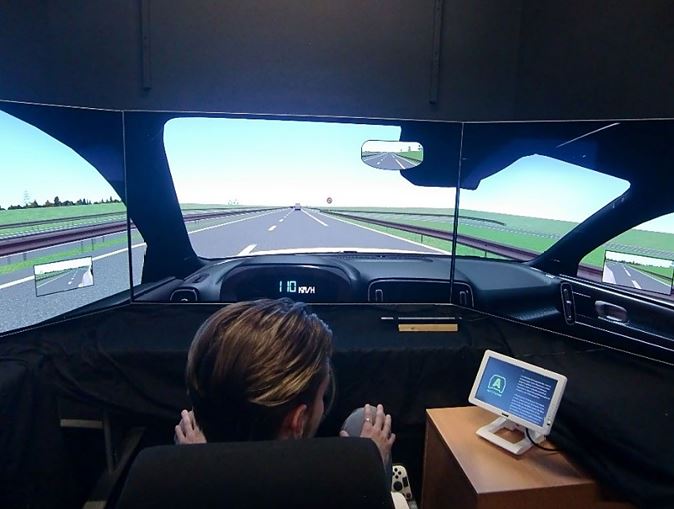
Performance on a multiple object tracking task predicts take-over success in simulated highly automated driving.
To determine whether visuo-attentional and executive capacities measured by multiple object tracking and related cognitive tasks are associated with take-over performance in a highly automated driving simulation.
Participants completed a battery of cognitive assessments including 3D multiple object tracking (NeuroTracker), executive function measures, and additional visuo-attentional tasks. These measures were correlated with performance outcomes in a high-fidelity driving simulator requiring participants to take over control from automated driving under risk-relevant conditions.
Higher dynamic tracking performance and stronger executive functioning were associated with greater take-over success in the simulated automated driving scenarios. These findings suggest that perceptual-cognitive abilities measured by 3D-MOT paradigms relate to practical visuomotor tasks beyond sport contexts, including safety-critical driving behaviors.

NeuroTracker baselines more sensitively detect effects on cognition than other cognitive assessments after open heart surgery.
To examine whether cognitive baselines can be used to detect changes in cognitive function in open-heart surgery patients.
16 open-heart surgery patients (av. 60 years) completed NeuroTracker, Montreal Cognitive Assessment, and Trails B assessments at 3 time points: 1 to 2 days pre-surgery, at discharge or 1-week post-surgery, and at 12-weeks post-surgery.
No significant differences were detected between baseline and 1-week/discharge measurements on all measures. Patients improved significantly from 1-week/discharge to 12-weeks in NeuroTracker baseline scores. A similar but non-significant trend was found on the Montreal Cognitive Assessment. The researchers concluded that post-surgical cognitive changes in heart surgery patients were detectable using NeuroTracker, and that future research should explore whether it is usable for the retraining of cognition after heart surgery.


To evaluate the potential for sports vision training to improve objective and subjective visuomotor function in a low vision patient.
A 37-year-old woman with Usher syndrome underwent a 14-week sports vision training program with pre-post cognitive assessments.
The patient was able to improve the use of remaining visual abilities. A 27 to 31% improvement in hand-eye coordination was achieved along with a 41% improvement NeuroTracker performance. The patient also subjectively reported clear improvements in visual abilities. The researcher concluded sports vision training may reduce the impact of the reduced visual function and aid in activities of daily living.


Individual with Autism can perform NeuroTracker at different cognitive loads and benefit from feedback at low difficulty levels.
To investigate the cognitive characteristics of individuals with with Autism compared to neurotypical individuals in response to different NeuroTracker loads and feedback.
27 adolescents and adults with Autism and 28 neurotypical adolescents and adults ASD were tasked with performing NeuroTracker at low load (1-target tracking) and high load (4-target tracking) across two sessions of training. Half of the participants received feedback on each trial, and half did not.
Although participants with Autism scored lower than neurotypicals, high load sessions were tolerated equally in comparison to low load sessions. Feedback improved NeuroTracker performance overall, except for participants with Autism on the high load sessions. Participants with Autism receiving feedback scored better than neurotypical participants without feedback, but only on the low load sessions. The results suggest that individuals with Autism can perform NeuroTracker at different loads, and that feedback aids performance at low difficulty levels.


NeuroTracker baselines reveal the longer-term and short term negative impacts of night shift duties on hospital physicians.
To evaluate the effects of night shift work on cognitive performance in medical resident physicians.
44 night shift physicians at Hospital General de Mexico were recruited. 12 students with day shift medical careers were also recruited as a control group.
Questionnaires recorded incidents or accidents suffered during or after a day on duty. Each night shift physician completed a 3-session NeuroTracker baseline (20-mins), both 24 hours before a night shift of duty, and at the end of the duty. The control group completed the same baselines before and after a normal day shift of duty. This was repeated again for both groups.
75% of the physicians reported incidents or accidents during their hospital activities, most commonly related to sleepiness during shift work. NeuroTracker pre-night shift baselines were significantly below that of the control group, suggesting some negative longer-term cognitive effects of night shift duties. Post-shift baselines were further significantly reduced (a 25% decrease), revealing short term negative effects of night shift duties. Improvements in cognitive performance from a total of 12 NeuroTracker sessions were found, indicating these effects may be partially mitigated with further NeuroTracker training. The researchers suggested the finding support the value of using such cognitive assessments for the evaluation of medical staff and quality of patient care.


NeuroTracker training transfers to significantly improved useful field of view, an ability strongly associated with driving skills.
To examine if NeuroTracker training transfers to useful field of view (UFOV) performance, a measure strongly associated with driving performance.
Twenty healthy young adults between the ages of 23 and 33 years were recruited and evenly assigned to either a NeuroTracker training program or active control group using a math game (2048). Both groups completed 5 hours of training distributed over 5 weeks. Both groups completed pre-post standardized assessments of UFOV.
The NeuroTracker training group exhibited significantly improved UFOV performance, whereas the active control group showed only a small, statistically nonsignificant improvement in the task. The researchers suggest that NeuroTracker and UFOV performance are likely dependent on overlapping cognitive abilities, and that these abilities can be trained and measured in young adults which could lead to improving driving safety.


The #1 Most Scientifically Validated Cognitive Training System in the world. Built on 20 years of neuroscience research by leading authorities in their fields. Improve your brain and performance.
.png)