


Welcome to the Research and Strategy Services at in today's fast-paced.
Cognitive training research is often debated on two fronts:
A newly published controlled study in the Journal of Digital Life (2026) directly addresses both questions in the context of NeuroTrackerX's remote training application in competitive soccer players.
Rather than focusing on laboratory-only systems, this study examined what happens when athletes train independently at home — and whether measurable changes occur in both cognitive performance and brain activity.
Title: Impact of Three-Dimensional Multiple Object Tracking (3D-MOT) on Cognitive Performance and Brain Activity in Soccer Players
Design: Controlled pre–post study
Participants: 29 university-level soccer players
Intervention: ~30 NTX sessions over 9 weeks (home-based)
Outcome Measures:
Unlike earlier sport performance studies without control groups, this study included a matched control group that continued regular training and performing only pre and post NeuroTracker baselines.
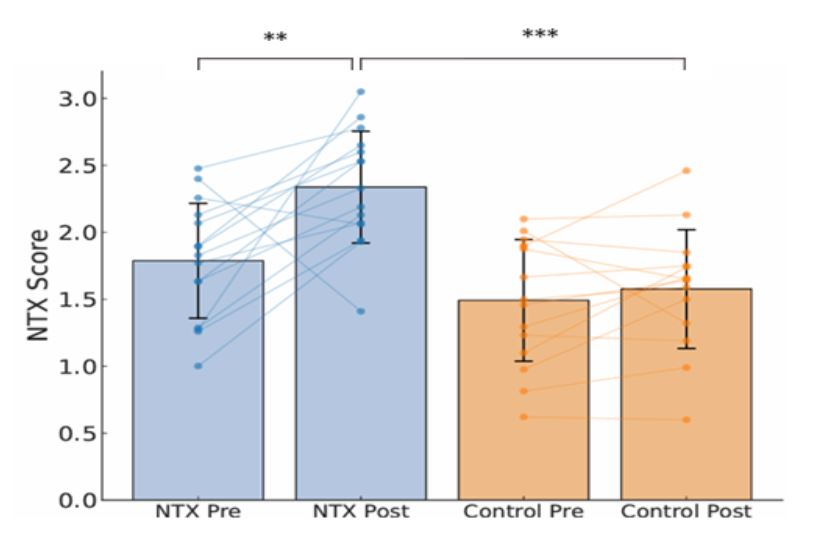
Participants who trained with NeuroTracker showed significant improvements in their tracking speed thresholds, while controls showed no improvement in pre post baselines.
Importantly, these gains occurred in a fully remote, self-directed format — not in a laboratory-controlled environment.
This supports feasibility and scalability.
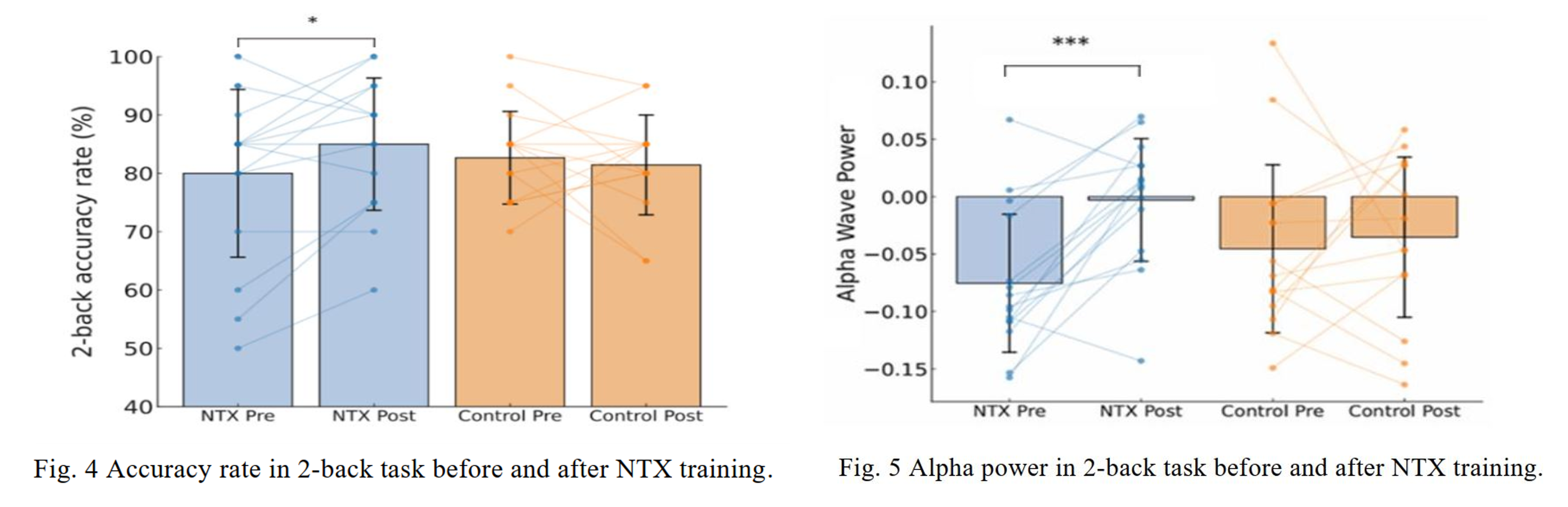
The NeuroTracker group demonstrated a statistically significant improvement in 2-back task accuracy.
The 2-back task requires:
However:
This pattern is notable.
It suggests transfer occurred under moderate cognitive load, but not under higher executive strain.
That boundary strengthens interpretive credibility.
Rather than implying broad, unlimited transfer, the data point toward selective enhancement of attentional regulation and short-term information updating.
One of the most important contributions of this study is the inclusion of EEG measurements.
During the 2-back task, the NTX group showed a significant increase in frontal alpha power after training.
Frontal alpha activity is commonly associated with:
In practical terms, increased alpha power during task performance may reflect improved neural efficiency — the ability to suppress distractions and prioritize task-relevant processing.
No significant changes were observed in frontal theta activity, which is often linked to heavy working memory load.
This aligns with the behavioral data:
The neural findings support the interpretation that NeuroTracker training primarily strengthened attentional control mechanisms rather than maximal working memory capacity.
Many cognitive training studies are conducted under tightly controlled laboratory supervision.
This study differed in three important ways:
Over approximately 30 sessions in 9 weeks, improvements were still observed.
This suggests that perceptual-cognitive training does not necessarily require centralized laboratory infrastructure to produce measurable effects.
For sports programs, distributed teams, and research scalability, that matters.
An additional strength of this study was its real-world adherence profile. Participants were asked to complete 30 NeuroTracker sessions over nine weeks in a fully home-based format. On average, athletes completed 28.5 sessions, with the majority reaching the full target. Monitoring was intentionally minimal — limited to a basic management interface and reminder-style check-ins — and was not designed to enhance motivation or performance.
These findings support the practical feasibility of distributed NeuroTracker training and align with previous research validating NeuroTrackerX as a research-grade tool for remote use: A Protocol for Remote Cognitive Training Developed for Use in Clinical Populations During the COVID-19 Pandemic
This research does not claim:
Instead, it provides evidence that:
That level of specificity is important in a field often criticized for overgeneralization.
The cognitive training field continues to examine:
This study contributes to that discussion in several ways:
Rather than framing cognitive training as a global enhancer, the data support a more precise interpretation:
Perceptual-cognitive training may strengthen attentional regulation systems, particularly under dynamic and moderate-load conditions.
In open-skill sports such as soccer — where players must track multiple moving elements while filtering interference — this type of attentional modulation may be functionally relevant.
Further research will be needed to determine:
This study adds to a growing body of literature suggesting that structured perceptual-cognitive training can:
It also reinforces an important principle in cognitive science:
Improvements are often selective, load-dependent, and domain-constrained — not universal.
For clinicians, researchers, and performance specialists evaluating digital cognitive tools, studies like this provide increasingly granular insight into how and where measurable effects occur.
And that specificity may be the most valuable outcome of all.
Saito, Y., Isogai, H., & Natsume, K. (2026).
Impact of Three-Dimensional Multiple Object Tracking (3D-MOT) on Cognitive Performance and Brain Activity in Soccer Players.
Journal of Digital Life, 5(S9).
Published February 20, 2026.
For a concise report of the study's methodology and key findings, see the science summary here: I mpact of 3D-MOT on Cognitive Performance and Brain Activity in Soccer Players
Welcome to the Research and Strategy Services at in today's fast-paced.
Healthy aging isn’t only about what changes with age, but also what capacity remains to adapt. This article explores how NeuroTracker research suggests cognitive adaptability remains surprisingly high in older adults.
The brain and body are often treated as separate systems, but NeuroTracker research suggests they are deeply connected. This review explores how perception, decision-making, attention, and movement interact across sport, driving, aging, fatigue, and motor performance.
Learn about an 11 year old boy's inspiring achievements using NeuroTracker training for sports and educational performance.
NeuroTracker is one of the most widely researched cognitive training systems, used in elite sports, military, and human performance settings worldwide. Built on 20 years of neuroscience research.